

Imagine a room full of people who all speak different languages.
To get them talking, you could have everyone learn everyone else's language. Fine, until someone new shows up. They start from scratch, and so does everyone else. Over and over. Or you bring in a single interpreter. Everyone speaks to the interpreter, the interpreter turns it into one shared language, and anyone new just does the same.
That interpreter is an integration layer. It won't win any awards for buzziest term of the year, but it's a huge gamechanger.
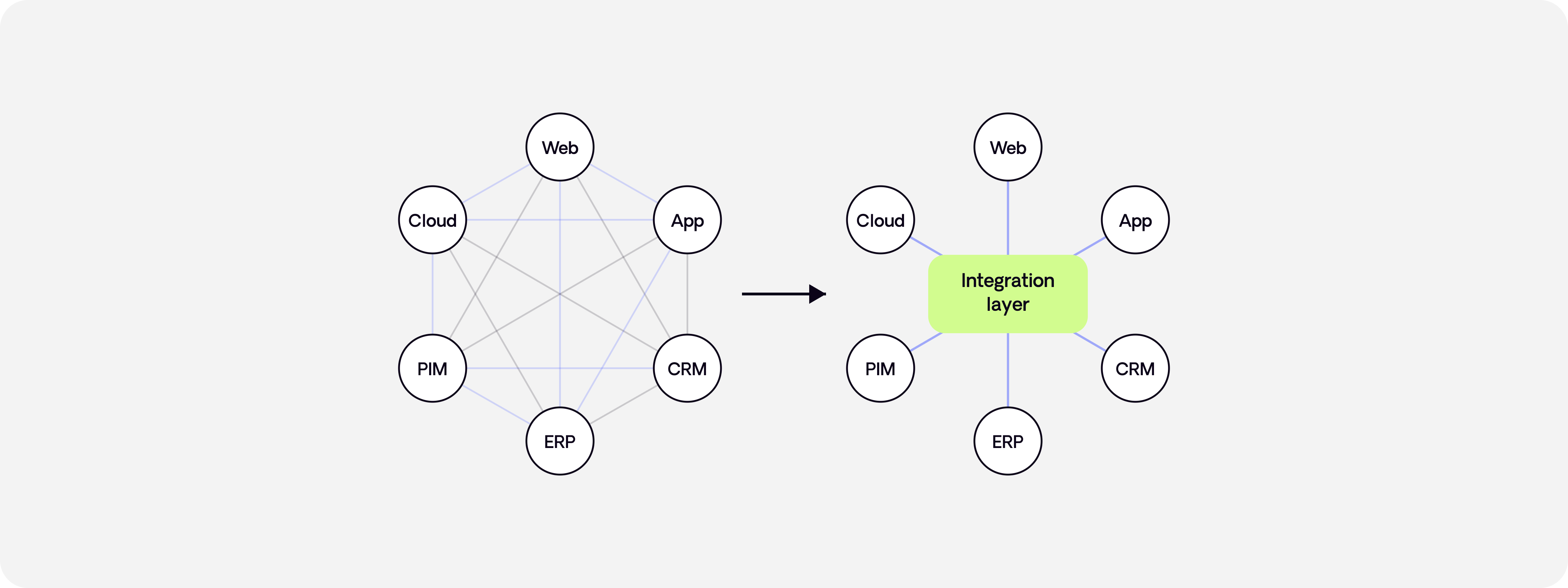
The people in that room are your systems: your ERP, CRM, PIM, webshop, inventory tool. Each keeps its own version of the truth, and every new channel means yet another connection to build.
So most companies patch it together as they go, one link at a time.
And that's how you end up with a tangle. Change one thing and it ripples off into the others, no telling how far. One app tweaks its data model and half your connections snap at once: orders never make it into the ERP, stock levels stop reaching the webshop. Everything grinds to a halt, and good luck finding where it broke.
The biggest problem: your company is full of valuable data, but you can't get anything out of it. It's too scattered, or too far out of reach.
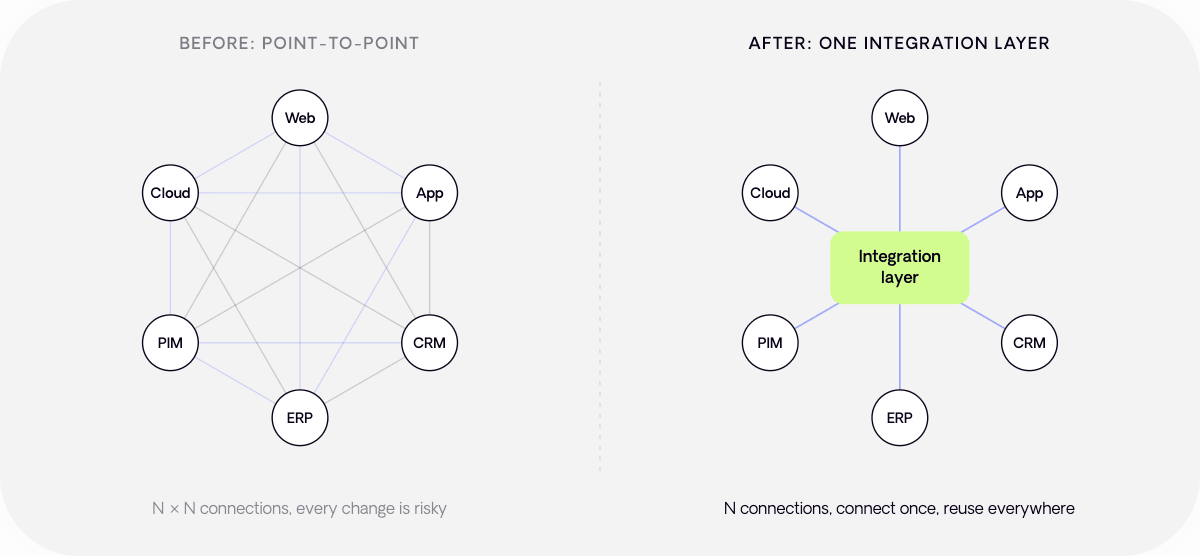
A central place all your systems talk to, instead of directly to each other.
Each system delivers its own data to that one layer. Your ERP calls someone a "debtor", your CRM an "account". The layer translates that into one shared model that you define, where "customer", "order" and "stock" mean the same thing everywhere.
Dozens of fragile links become one clean connection per system. And you own the data model, not your vendor. No more moving at their pace and rules.
Not long ago this was simply good architecture. Nice to have, easy to skip.
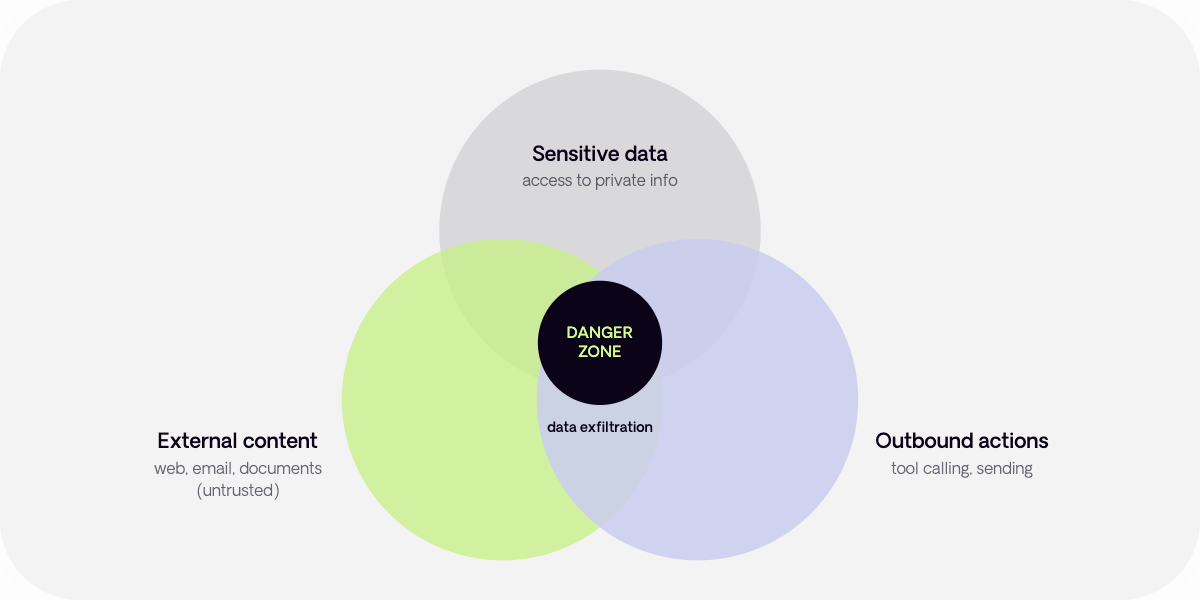
Not anymore. AI agents need your data flowing steadily and consistently to do anything useful, and an agent reasons across several systems at the same time. Let "customer" mean one thing here and another thing there, and it'll happily draw the wrong conclusion, without ever tipping you off.
Then there's security. Hand an agent the keys to all your raw data and pretty soon nobody knows who touched what. Route it through the integration layer instead, and the layer decides case by case what the agent can see and do, logging every move. So you can always trace what happened and undo a mistake.
In other words: the very layer you build to untangle your systems is the same one your agents need to work safely and reliably.
You don't always. Just after a small automation? The full layer is overkill, and the cost won't earn its keep.
It starts paying off once things get bigger: several applications at once, data from different systems pulled into one picture, or the point where you want agents working on your data. Stay pragmatic and build only what the business truly needs.
Curious what this would look like across your own systems? Download the full explainer to see how to untangle your data, keep your organisation agile, and get AI-ready from day one.
Rather walk through your own situation together? We're happy to think along, no strings attached. Just drop Manu or Guillaume a message.

The full explainer digs a lot deeper. Inside you'll find: