


For years, the software world had one rule: whoever had the biggest team, won. Large consultancies ran on volume, brand recognition, and big budgets. That model worked. Until AI made it obsolete.
Because when everyone can deliver a lot of work with AI, volume stops being a differentiator. What matters now: expertise. The ability to think along. A partner that challenges your assumptions and knows how to build for the future.
Companies with 15 to 20 years of head start are watching that advantage evaporate. They're stuck in outdated processes, rigid structures, and a culture that treats change as a threat rather than an opportunity. Reskilling takes time. Changing culture takes even more time. And the market? It doesn't wait.
Meanwhile, lean teams that embraced AI from day one are in a better position. Not because they're bigger, but because they move faster, carry less baggage, and don't have red tape. While the big players are still meeting about their AI strategy, we're already building with it.
For a long time, the perception was simple: SaaS is cheap, custom is expensive. For many businesses, custom development didn't even seem like an option. But AI-driven development is changing that equation at its core.
The implementation cost of custom software is dropping. Speed is increasing. And flexibility stays fully intact. What used to be feasible only for multinationals is now within reach of every mid-market company. A back-office digitization that was too expensive two years ago? It's now well within budget.
And that's the crux. It's tempting to ship fast and ship a lot. AI makes that possible. But a large application that solves the wrong problem isn't a win. It wastes your time, your budget, and your team's confidence.
The real work is less about writing code. It's about understanding what exactly you need to build, why, and how to make it pay off in the long term.
Our thinking is now even more important than our pure execution. Thinking about sound technical architecture. Making sure you build the right thing for your context. Ensuring software is scalable, stays reliable, and can be functionally extended as your business evolves. That's what we've continuously invested in over the past years.
And it's precisely that expertise that is now worth more than ever.
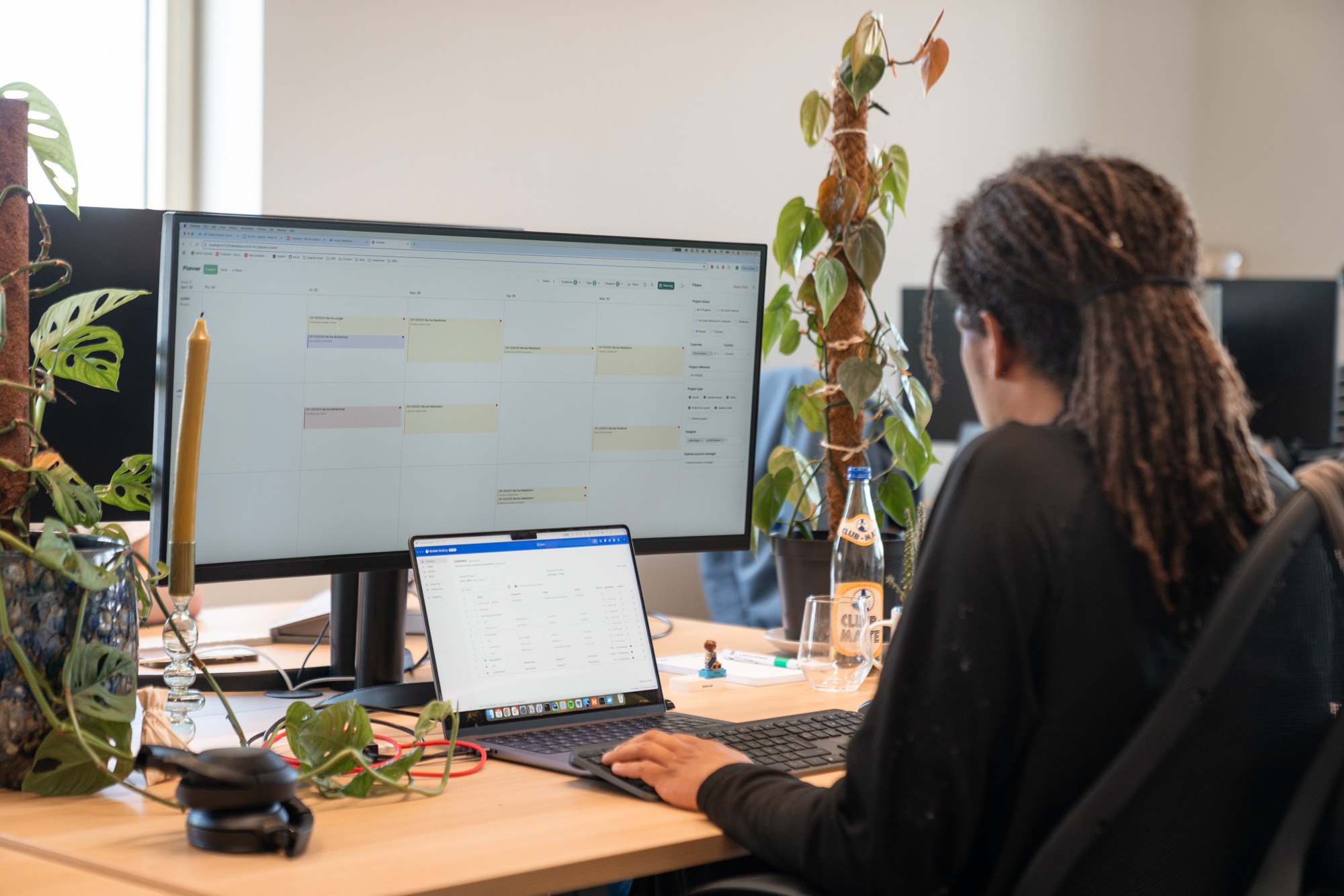
Processes that were hard to automate a year ago aren't anymore. Every organization has a spreadsheet somewhere that should be an application. An admin task that takes ten hours a week when it should take two. A data flow that gets manually corrected every month.
Digging into that process, choosing the right solution, and then actually making it work: that's what we're good at. AI makes it faster and cheaper. The right expertise makes it good.
A competitor who does invest is building an advantage that grows every month. Sitting still because "it's always worked this way" means losing ground. And not slowly.
Those who wait pay the price. In efficiency, in margins, in talent that leaves for companies that are ahead. AI is no longer a hype. Just like the web was no longer optional in 2005.
We use AI as a tool, not as a replacement for expertise. Concretely, that means: AI helps us review code for quality and security before it enters your system. It helps us get up to speed faster in an existing codebase so we don't waste time understanding what's already there. It helps us iterate faster and deliver a first working version sooner. It enables us to do deeper problem analyses before we write a single line. And it actively monitors for bugs and issues after a project goes live.
What AI doesn't do: make decisions. Not about architecture, not about scope, not about what the right solution is for your specific situation. That remains human work. Our engineers remain owners of what they build, from the first line of code to the last deployment.
The result for you: faster delivery, fewer errors, and a team that has more time for the complex challenges that truly matter.
