

Every month, 30 hours were spent on invoicing. Manually calculating rates and doing it for dozens of care facilities and healthcare workers at once. All tracked and calculated in a spreadsheet. That was the reality at EvaCare, a Belgian company staffing nursing and care professionals at residential care homes. A process that was not just incredibly time-consuming, but also error-prone and entirely dependent on a single person.
That had to change. And with AI as our accelerator, we made it happen in record time.
an invoicing process screaming for automation
EvaCare manages the scheduling and invoicing of healthcare workers deployed across various residential care homes. Every month, worked hours were exported from Beeple (their scheduling platform) and then manually processed into invoices in Billit (their accounting platform).

Sounds simple? It’s not. Behind every shift lies a maze of rules:
Doing that manually every month doesn’t just cost 30 hours, it also carries risk. All the knowledge lived in one person’s head, and a single mistake could have immediate financial consequences.
one click, the system handles the rest
We built an application that automates the entire invoicing process.
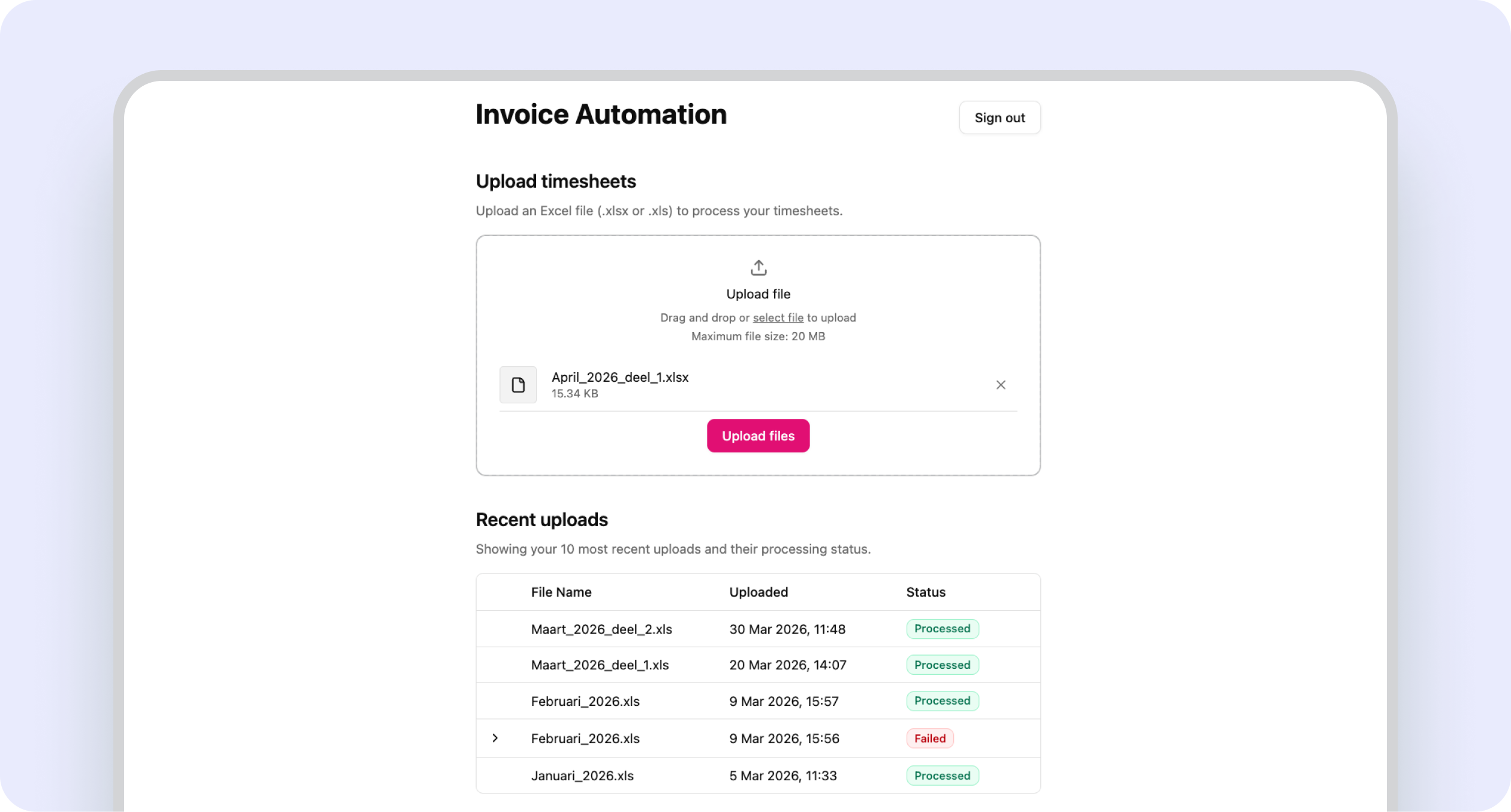
The flow is simple: EvaCare exports their worked hours from Beeple and the custom tool does the rest. Splitting, calculating, and invoicing, without any manual intervention.

Here’s what happens under the hood:
build faster, iterate smarter
This project shows exactly what AI-augmented engineering makes possible on a complex, rule-driven domain. AI is woven into how we think, architect, and deliver.
Speed that used to be impossible
A complex logic layer, two platform integrations, and configurable rates per care facility and per province. Built and delivered in a matter of weeks. With the way we worked five years ago, that timeline simply wasn’t realistic.
AI-augmented development makes every engineer faster. Absolutely not by sacrificing quality, but because AI handles the heavy lifting in writing, debugging, and testing. What’s left for our team: the real thinking and taking full ownership for the client. Architecture, edge cases, and an application that truly solves the problem. Always with a proactive mindset. That’s us.
From business case to ROI: AI lowers the barrier
AI has fundamentally changed the equation for custom software. Lower development costs, faster delivery, an ROI within 1 to 2 years.
AI across the entire project lifecycle
We don’t just use AI for development. The entire trajectory, from scoping and analysis to project management and documentation, was powered by AI. Take the analysis of the complex invoicing rules, for instance — rapidly translated into technical specifications.
The result: more value in less time. Not by cutting corners, but by exponentially scaling our team’s capacity with the right tools.
bring it on!
We like a good challenge. And this one delivered. The complexity isn’t in the interface, that’s intentionally minimalist. The complexity lives in the logic behind it.
A custom-built automation
Every timesheet runs through a set of rules that determines how a shift gets split, which rate applies, and which coefficient is used. An overnight shift from weekday to weekend? That requires multiple splits with the correct coefficients per segment. Every edge case was designed, configured, and battle-tested.
Integration with two external platforms
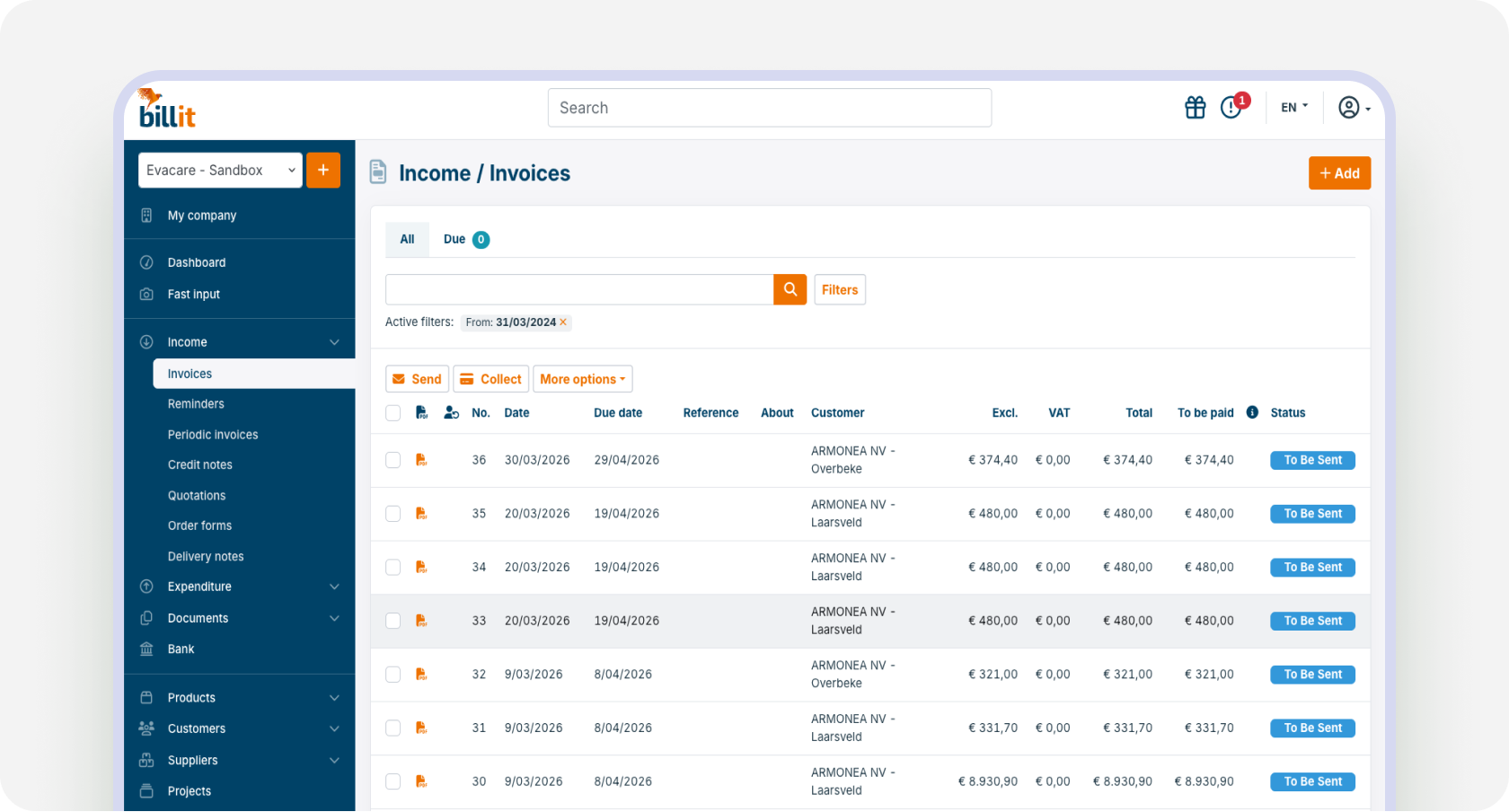
The application bridges two worlds: Beeple for worked hours and Billit for invoicing. Everything is brought together in one automated flow.
Configuration without code
Rate changes, new holidays, provincial surcharges… The system is built so EvaCare stays flexible going forward without needing to call us every time. Though we’re always happy to help, of course!
The invoicing process that used to take 30 hours per month has been reduced to a fraction. The manual steps are gone. EvaCare uploads an Excel and the system delivers invoices in Billit, ready for review and dispatch.
What that means in practice:
The time freed up? It now goes toward what truly matters: client relationships, quality control, and growth.




.png)


