

.png)
By Arne Dierickx (software engineer)
Getting software delivered faster, without quality taking the hit. That's the expectation businesses have today, and it's a completely fair one. AI makes it more possible than ever.
At we are, we build custom software that automates the manual work running behind your business. Not with a team of a hundred, but with a smaller team of software engineers who treat AI as a full part of the engineering process. Why? Because that's the time we live in. You can't help businesses digitize if you're still working with 5-year-old technology yourself. That's why we stay on top of our game.
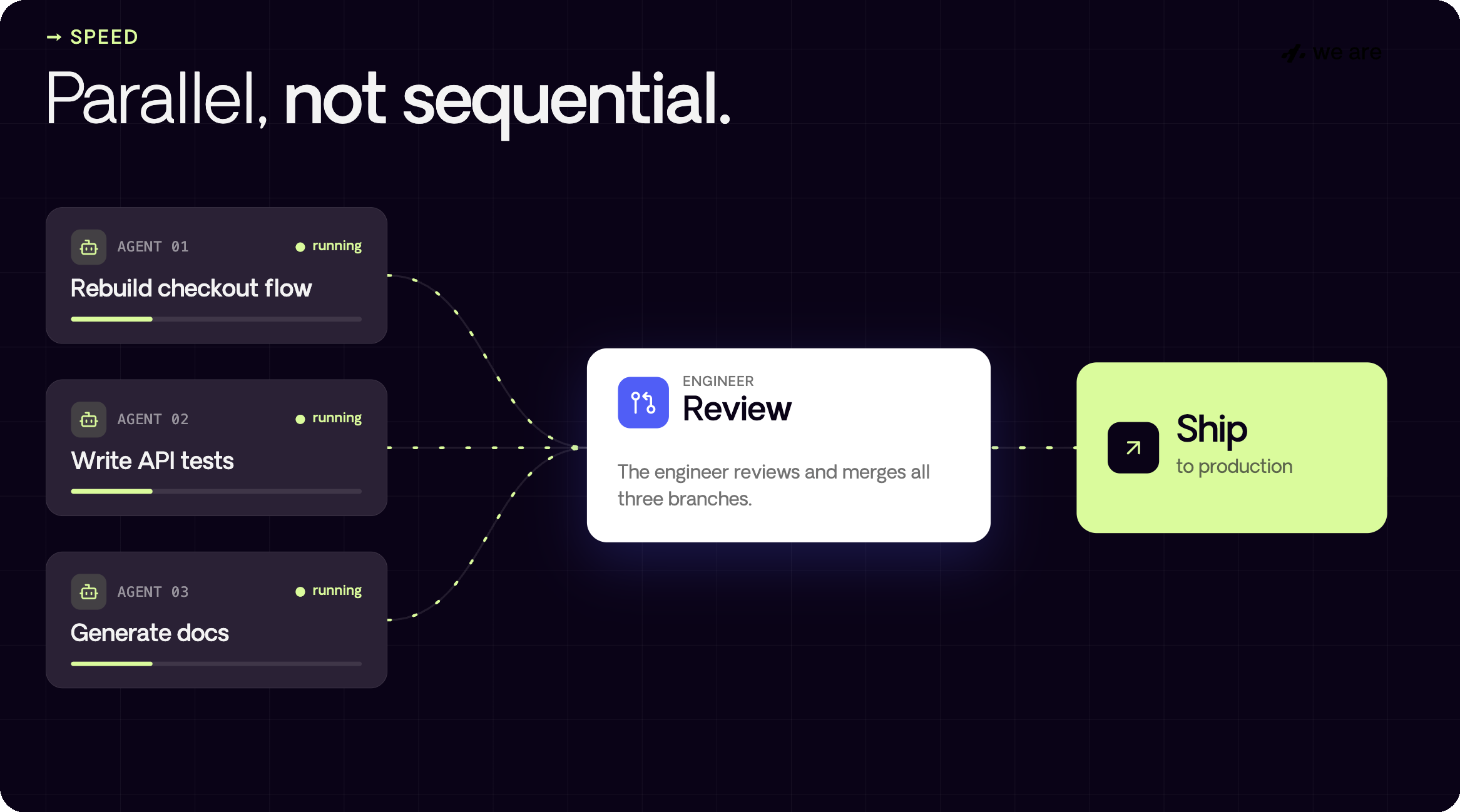
Take a platform we're building right now: a mobile app, two dashboards, and an API. Three applications, one project, multiple agents working on it simultaneously. Due to a multi-agent workflow, we were able to deliver fast and they got a bunch of extra features.
An AI coding agent is software that can work on code independently, without needing to be guided step by step. You give it clear instructions on what to build and how, and it gets going: it reads the existing codebase, makes changes, tests the result. Think of it as a digital colleague who picks up a task and handles it end to end.
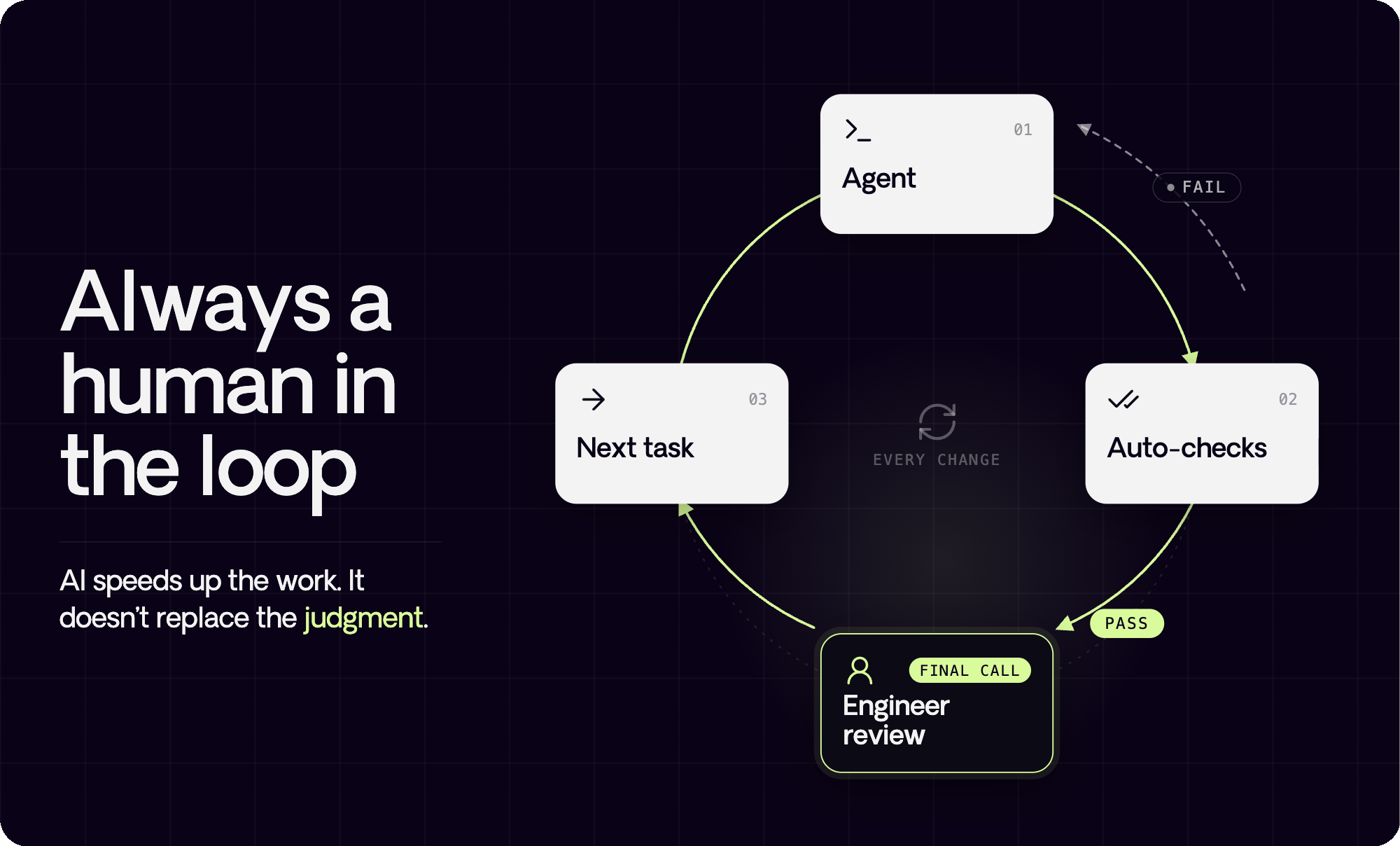
In practice: multiple agents work on your project at the same time, like a team building the software in parallel. Only now, it's just one very skilled software engineer. That may put the most important concern to rest straight away: an engineer reviews every piece of work that comes out of those agents.
The agents handle the volume. Our engineers keep the hard work and the judgment. The long-term sustainability of your software will always be our responsibility.
We often use Claude Code from Anthropic for this, alongside other tools. But the tool isn't the story. The story is how you deploy them so the result gets better, never worse.
Hand an agent your codebase without any context, and you've hired someone who shows up on day one with zero onboarding. The result is inconsistent code, wrong calls, and decisions that don't fit what's already there. But that's not how we're doing it over here. With years of experimentation and learning, we can say that the engineers are pretty comfortable defining context.
Not enough or the wrong context is exactly why a lot of people conclude that AI isn't ready for serious work. As we'd say: skill issue.
Every agent working on the project gets the right context first. And just like you have to invest time in bringing a junior developer up to speed, you have to invest time in bringing your AI agents up to speed.
We build that context in three layers: a central project document, a dedicated guide for each component, and explicit rules of the game. Each one is explained below.
One central file that describes the entire project. Written for agents, not for humans. The architecture, the technologies in use, the conventions, the ground rules. Think of it as an onboarding document and a technical bible rolled into one.
It's not static either: agents update it themselves when they spot something missing or incorrect. That way it evolves with the project, as it should.
If the project document is the map, the skill guides are the detailed instructions. There's one for each part of the software: for the app, for the dashboards, for the technical engine underneath. Plus guides for recurring tasks, like writing tests or processing feedback. Each one is written as if you're onboarding an experienced developer who knows their craft inside out, but has never seen this project before.
Multiple agents on the same project need boundaries, otherwise things fall apart quickly. Each agent has a clearly defined territory and stays within it. No agent makes important decisions on its own: when in doubt, they stop and ask.
And perhaps the most important rule of all: agents are not yes-machines. We tell them explicitly that they're allowed to push back. If an approach is unnecessarily complex, we want to hear it. If something's missing, they stop and ask rather than inventing an assumption and building on top of it.
.png)
We built a system that automatically picks up feedback on code, carries out the changes, checks that nothing broke, and wraps everything up cleanly. Work that used to take a developer around 30 minutes each time now happens in seconds.
We've learned a lot more about AI and agentic AI than just these five things over the past few years. Happy to talk if you're interested!
For us, AI is a permanent part of how we build, on every project. The difference from two years ago isn't only better tools, though those exist too. It's that we've learned how to deploy them structurally. Not as a replacement for our engineers, but as a serious force multiplier.
The companies investing in this now are building an advantage that compounds fast, and AI is reshaping the software market faster than most expect. Wait it out, and next year you'll be catching up on what everyone else figured out a while ago.
For our clients, it comes down to this: your idea in working software, faster, at a cost that makes sense, built by a team that keeps the technical side in hand. Whether you're weighing custom software or an existing platform, a business case that wasn't worth pursuing two years ago very likely is now.
Curious what this could mean for your project? Let's talk.
